Croatia
Dragana Prvulović
Antifascism in Croatia has its roots in the Second World War, most prominently through the resistance of the communist Partisans against the Nazi occupation. This movement was not only remarkably effective—among the most successful antifascist efforts in occupied Europe—but it also became the cornerstone of socialist Yugoslavia’s legitimacy, framing the new state as a triumph over fascism. Yet, this legacy began to erode with the resurgence of nationalist sentiment in the 1980s. By the time Croatia declared independence in 1991, the memory of antifascism had been increasingly sidelined and delegitimized, overshadowed by a dominant national narrative that recast historical memory in ethnic and nationalist terms.
The Croatian constitution explicitly anchors the state’s foundation in its antifascist legacy, not in the legacy of the fascist Independent State of Croatia. Yet despite this formal affirmation, the state has repeatedly proved reluctant to confront the increasingly visible network of revisionists and self-appointed “experts,” as well as various civil society organizations, public personalities, and media actors who promote genocide denial and normalize the use of symbols from the fascist past. During the period when Croatia was seeking European Union membership, the state pursued a wave of liberalization and cooperation with the ICTY, signaling a temporary alignment with international norms. However, once EU accession was achieved in 2013, a marked shift occurred toward re‑traditionalization and conservative politics, accompanied by increased tolerance for fascist and revisionist expressions. This reluctance has become more striking since 2024, when the Croatian Democratic Union (HDZ) entered into a governing coalition with the far-right Homeland Movement (DP), a partnership signaling state accommodation—if not explicit endorsement—of far-right forces and their revisionist politics. Persistent controversies over symbols such as the fascist “Za Dom Spremni” salute continue to test the boundaries of acceptable nationalist expression (Brentin 2016). These tensions intersect with enduring problems around Holocaust distortion, and the systematic denial or minimization of genocidal crimes committed against Serbs during World War II (Subotić 2019). Collectively, these developments underscore the fragility of antifascist memory in contemporary Croatia.
So, what does antifascist engagement look like in the post-socialist and post-conflict era? As socialist Yugoslavia fractured, those committed to antifascist principles joined antiwar mobilizations and emerging human-rights initiatives. In the war’s aftermath, a defiant current of antinationalist politics slowly took shape in Croatia. It grew largely out of the anarcho-punk scenes of Pula, Rijeka, and especially Zagreb, at times overlapping with other activist circles. It is important to recognize the difficulty of nurturing such countercultural politics during a period marked by an unmistakable shift to the right. Sustaining these practices, and the alternative ways of living and imagining they demanded, required an unusual degree of personal and political commitment from the young activists who carried them (Razsa 2015).
Antifascist commemorations remain an important site of memory in Croatia, albeit a contested one. Antifascist organizations continue to mark Antifascist Struggle Day on June 22nd, often with the participation of state officials or representatives, reflecting a formal acknowledgement of Croatia’s wartime resistance. However, these antifascist commemorations are consistently overshadowed in the public sphere by other high-profile nationalist commemorative events, such as the Remembrance Day for the Victims of the Homeland War in Vukovar, which receive intensive media coverage. The socialist-era Uprising Day on July 27th is still observed by the Croatian Serb national minority and its political representatives, alongside Croatian antifascist groups. These commemorations, however, frequently encounter counter-demonstrations and protests, highlighting the ongoing tensions around the public recognition of antifascist history and its contested place within contemporary political and social life (Pavlaković 2012). The neglect of socialist-era monuments to antifascism further illustrates how these sites and practices struggle to maintain visibility in a memory landscape dominated by nationalist narratives.

The socialist-era Monument to the Uprising of the People of Kordun and Banija. Source: Spomenik Database.
These social and political tensions became dramatically visible during the July 2025 concert in Zagreb by Marko ‘Thompson’ Petković, a 1990s war veteran and popular folk singer. Rumoured to be the largest concert in Croatian history, hundreds of thousands of spectators gathered at the Zagreb Hippodrome, where the ‘Za Dom Spremni’ slogan and Ustaša-era chants reportedly resonated among the crowd. The event was criticized by many for celebrating a fascist-era legacy under the guise of patriotic spectacle.
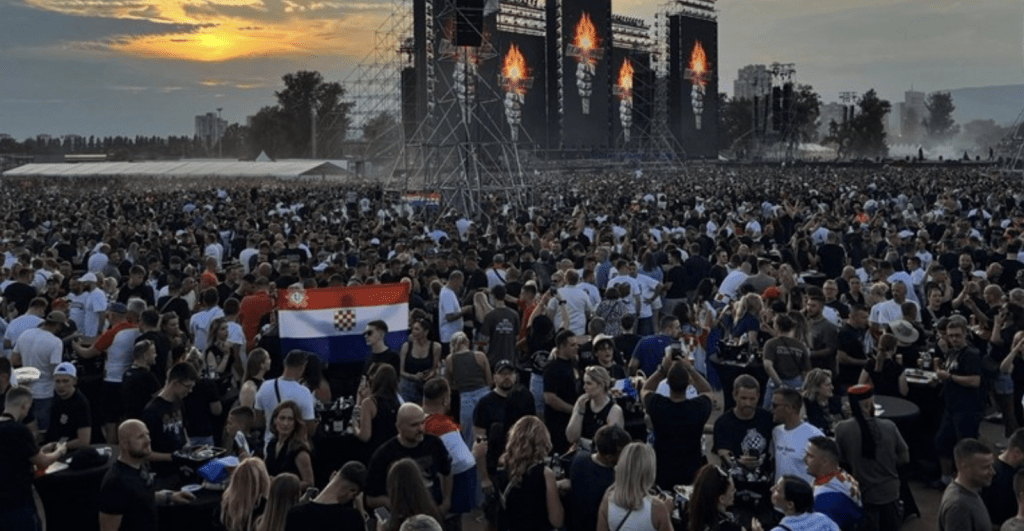
Image from the 2025 Thompson concert in Zagreb, showing fans displaying the WWII-era fascist flag of the Independent State of Croatia. Source: Index Vijesti.
While older generations of antifascists in Croatia are often primarily engaged in commemorative events at socialist-era monuments, younger activists have increasingly taken a more proactive and confrontational stance, organizing marches and counter-protests to challenge the resurgence of nationalist and fascist symbolism. Most recently, over a dozen anti-fascist organizations, collectives, and initiatives collectively organised a march against fascism in response to a series of provocations following the Thomspon concert, including several incidents of censorship of left-wing festivals by veterans associations and threats made against the Croatian Serb national minority by crowds of masked men. The event, scheduled for November 30th 2025, calls all citizens to march against hatred and violence. Simultaneous marches have also been organized in Zadar, Rijeka and Pula.
Such mobilizations occur alongside more established annual activities, such as the Trnjanski Kresovi to mark the liberation of Zagreb (May 8th), organized by the Mreža Antifašistkinja Zagreb. This event includes food, workshops, panels, merchandise booths, and concerts by antifascist choirs and bands, as well as a much-anticipated bonfire lighting ceremony.

The poster for the United Against Fascism March in Zagreb. Source: Novosti Hrvatska.
Recommended Readings:
Brentin, Dario. 2016. “Ready for the Homeland? Ritual, Remembrance, and Political Extremism in Croatian Football.” Nationalities Papers 44 (6): 860-876.
Čolović, Nina. 2023. “Psametihova djeca, ili kojim će jezikom progovoriti revolucija.” Antipolitika, 3: 159-183.
Hodges, Andrew. 2018. Fan Activism, Protest and Politics: Ultras in Post-Socialist Croatia. London: Routledge.
Horvat, Srećko and Igor Štiks. 2015. Welcome to the Desert of Post-Socialism: Radical Politics After Yugoslavia. London: Verso Books.
Jansen, Stef. 2005. Antinacionalizam: Etnografija otpora u Beogradu i Zagrebu. Beograd: Biblioteka XX Vek.
Jović, Dejan. 2017. Rat i Mit: Politika identiteta u suvremenoj Hrvatskoj. Zagreb: Fraktura.
Pavlaković, Vjeran and Davor Pauković. 2019. Framing the Nation and Collective Identities: Political Rituals and Cultural Memory of the Twentieth-Century Traumas in Croatia. London: Routledge.
Razsa, Maple. 2015. Bastards of Utopia: Living Radical Politics After Socialism. Bloomington, IN: Indiana University Press.
Schäuble, Michaela. 2014. Narrating Victimhood: Gender, Religion, and the Making of Place in Post-War Croatia. Oxford: Berghahn Books.
Subotić, Jelena. 2019. “Croatia’s Islands of Memory” In Yellow Star, Red Star: Holocaust Remembrance After Communism. Ithaca, NY: Cornell University Press.
 Worldwide Antifascism Research Network