Hugo Garcia
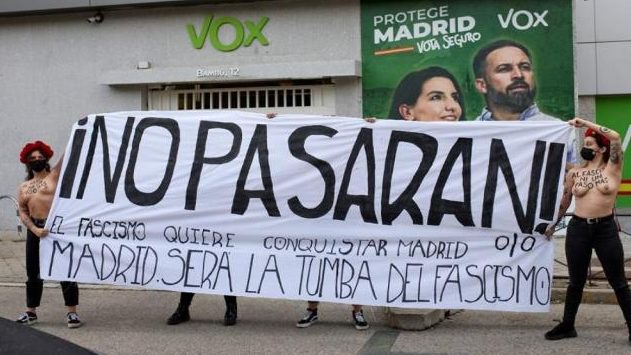
Despite its neutrality in World War I and the comparative weakness of its early fascist parties, Spain witnessed one of the strongest responses to fascism in the interwar period and became the pivotal centre of antifascist action and attention during its 1936-39 civil war. Spanish antifascism was strongly influenced by other European varieties, particularly in France, Germany and Italy, but remained distinctive in the force of revolutionary, anticlerical and separatist tendencies, which mirrored the characteristics of the local workers’ movement and, inversely, the idiosyncrasy of National Catholicism. For this reason, authors such as Seidman (2017) have branded it a case of ‘revolutionary antifascism’, simplifying a diverse, competitive and bitterly contested space which contained moderate and democratic currents under the umbrella of the Popular Front formed in early 1936. This misrepresentation, connected to the crushing defeat of the Republic in 1939 and to a deep-rooted Sonderweg view of the Spanish left, has been challenged by studies focusing on the plurality of Spanish antifascism (Gallego 2007, García 2016), its connections to the ‘global left’ (Fronczak 2023, Featherstone 2013, García 2020) and its hybridizations with other social movements such as feminism and the youth (Yusta 2016, Souto Kustrin 2013). Recent scholarship has also started to explore the persistence of an underground antifascist tradition during the long Francoist dictatorship (Marco 2016), among the Republican exiled communities (Martínez Martínez 2021) and around the Transition to democracy (Valencia-García 2020), as well as its periodic revival under the current democracy (Soro 2016, Ramos 2022) and post-fascist parties such as VOX (Franzé and Fernández Vázquez 2021, Santamarina et al. 2021).
Beyond Spain, the unprecedented international mobilization stirred by the Civil War has remained a key site of memory for antifascists around the world, from the anti-Nazi Resistance in World War II (Falkov et al. 2020) to the postwar Soviet bloc (McLellan 2004), social-democratic Sweden (Scott 2009), Latin American revolutions and counterrevolutions (Weld 2018 and 2019), global popular culture (Contreras Zubillaga and Moreda Rodríguez 2024) and, most recently, the logo of the Nouveau Front Populaire that narrowly won the French elections of June 2024. Seen as a local or as a global phenomenon, antifascism in and around Spain remains a vast and open topic, intersecting with key aspects of contemporary history and culture, that offers exciting and potentially unlimited opportunities for future scholarship.
References
Contreras Zubillaga, Igor & Moreda Rodríguez, Eva. 2024. ‘Spain in our Ears’: International Musical Responses in Support of the Republic during the Spanish Civil War. Routledge.
Falkov, Yaacov, et al. 2020. “The ‘Spanish Matrix’: Transnational Catalyst of Europe’s Anti-Nazi Resistance.” Fighters across Frontiers: Transnational Resistance in Europe, 1936–48, edited by Robert Gildea and Ismee Tames, Manchester University Press, pp. 31–48.
Featherstone, David. 2013. Black internationalism, subaltern cosmopolitanism, and the spatial politics of antifascism. Annals of the Association of American Geographers, 103(6), 1406–1420.
Franzé, Javier and Fernández-Vázquez, Guillermo. 2021. “The Spanish post-fascist right: The unique case of Vox”. Global Resurgence of the Right. Conceptual and Regional Perspectives. Edited By Gisela Pereyra Doval and Gastón Souroujon (pp. 173-197). Routledge.
Fronczak, Joseph. 2023. Everything is Possible: Antifascism and the Left in the Age of Fascism. Yale University Press.
Gallego, Ferran. 2007. Barcelona, mayo de 1937: la crisis del antifascismo en Cataluña. Barcelona, Debate.
García, Hugo. 2016. “Was there an Antifascist Culture in Spain during the 1930s?”. Rethinking Antifascism: History, Memory and Politics, 1922 to the Present, edited by Hugo García, Mercedes Yusta, Xavier Tabet and Cristina Clímaco. Berghahn Books, pp. 92–113.
García, Hugo. 2020. World Capital of Anti-Fascism? The Making –and Breaking– of a Global Left in Spain, 1936-39, in Anti-Fascism in a Global Perspective: Transnational Networks, Exile Communities, and Radical Internationalism, editedby Kasper Braskén, Nigel Copsey and David Featherstone. Routledge. pp. 234–253.
Ramos, Miquel. 2022. Antifascistas. Así se combatió la extrema derecha española desde los años 90. Capitán Swing.
Marco, Jorge. 2016. Guerrilleros and Neighbours in Arms: Identities and Cultures of Anti-fascist Resistance in Spain. Sussex Academic Press.
Martínez Martínez, Alba. 2021. “Motherhood, labor, and anti-fascism: the construction of refugee identity by Spanish women exiled in France, 1939–1976”. Journal of Iberian and Latin American Studies, 27(1), 7–26.
McLellan, Josie. 2004. Antifascism and Memory in East Germany: Remembering the International Brigades 1945-1989. Clarendon Press.
Santamarina, Ana. 2021. “The Spatial Politics of Far-right Populism: VOX, Anti-fascism and Neighbourhood Solidarity in Madrid City”. Critical Sociology, 47(6), 891-905
Scott, Carl-Gustaf. 2009. “The Swedish Left’s Memory of the International Brigades and the Creation of an Anti-Fascist Postwar Identity. European History Quarterly, 39(2), 217–240.
Seidman, Michael. 2017. Transatlantic antifascisms: from the Spanish Civil War to the end of World War II. Cambridge University Press.
Soro, Javier Muñoz. 2016. In Search of the Lost Narrative: Antifascism and Democracy in Present-Day Spain. Rethinking Antifascism: History, Memory and Politics, 1922 to the Present, edited by Hugo García, Mercedes Yusta, Xavier Tabet and Cristina Clímaco. Berghahn Books. pp. 276–299.
Souto Kustrín, Sandra. 2013. Paso a la juventud. Movilización democrática, estalinismo y revolución en la República Española, Universitat de València.
Valencia-García, Louie Dean. (2020). “Pluralism at the Twilight of Franco’s Spain: Antifascist and Intersectional Practice”. Fascism, 9(1-2), 98–120.
Weld, Kirsten. 2019. “The other door: Spain and the Guatemalan counter-revolution, 1944–54”. Journal of Latin American Studies, 51(2), 307–331.
Weld, Kirsten. 2018. “The Spanish Civil War and the Construction of a Reactionary Historical Consciousness in Augusto Pinochet’s Chile”. Hispanic American Historical Review, 98(1), 77–115.
Yusta, Mercedes. 2016. “The Strained Courtship between Antifascism and Feminism: From the Women’s World Committee (1934) to the Women’s International Democratic Federation (1945)”. Rethinking Antifascism: History, Memory and Politics, 1922 to the Present, edited by Hugo García, Mercedes Yusta, Xavier Tabet and Cristina Clímaco. Berghahn Books. pp. 167–184.
 Worldwide Antifascism Research Network