United Kingdom
Alex Carter
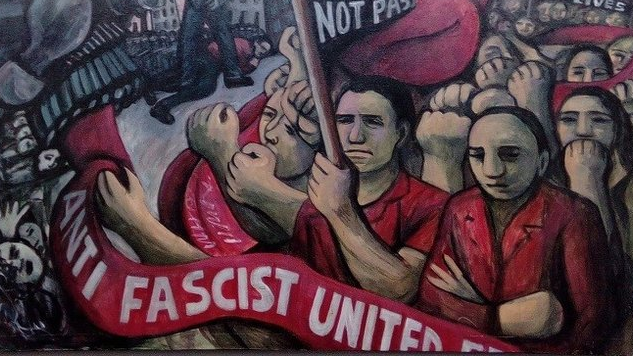
The emergence of antifascism as a large-scale movement in the UK is tied to the rise of Oswald Mosley’s British Union of Fascists (BUF), following their founding in 1932. A diverse range of groups, including Jewish organisations, working-class communities, communists, socialists and the labour movement mobilised against Mosley’s Blackshirts. The Battle of Cable Street in October 1936, which saw 100,000 Jewish and working-class anti-fascists successfully prevent a BUF march through East London, stands as a pivotal and iconic moment in this history.
The post-war far right was initially very fractured, but those groups such as Mosley’s Union Movement that were active faced opposition from the antifascist 43 Group, 62 Group, and Searchlight Magazine. However, the formation of the National Front in 1967 presaged the first major wave of post-war antifascist activity in the UK. Street mobilisations by groups such as the Socialist Workers Party led to large-scale clashes, including the Battle of Lewisham in August 1977. Yet this period also saw more innovative manifestations of antifascist organising. In particular, Rock Against Racism (RAR) and the Anti-Nazi League (ANL) achieved striking successes by combining music and political campaigning. Enormous numbers of British youth were mobilised by this campaign, with major RAR and ANL events being attended by crowds of 70,000-100,000 people
In 1985, a new UK-wide antifascist organisation was founded: Anti-Fascist Action (AFA). AFA was a decentralised network of activists who employed both direct action tactics and cultural campaigning to oppose the far right. Large-scale street mobilisations, such as the Battle of Waterloo in 1992, led to AFA earning a reputation as a ruthlessly efficient militant antifascist group. However, their cultural activities – including the RAR-inspired Cable Street Beat, their “Freedom of Movement” campaign to politicise the dance and rave subcultures, and their Unity Carnivals – demonstrated their ability to effectively use culture as a way to forge bonds between the antifascist movement and a range of communities and constituencies. In the 1990s the rise of the fascist British National Party as the dominant British far-right group provoked the founding of other large anti-fascist organisations such as Youth Against Racism in Europe (YRE), as well as the re-emergence of the Anti-Nazi League.
By the late 1990s, AFA began to decline due to internal divisions, police repression, and the changing nature of the far right. However, the anti-fascist movement has remained vibrant and active. Local antifascist groups, such as the London Anti-Fascist Assembly, Brighton Antifascists, and the North East Antifascists (as well as the national Anti-Fascist Network) are active across the country. At the same time, groups such as Red Flare, South London Scum, Clapton Community Football Club, Hope not Hate, and the Institute of Race Relations showcase the breadth of antifascist cultural and investigative work that continues within the UK.
Further Reading
Carter, Alex (2018): ‘The Dog That Didn’t Bark? Assessing the Development of “Cumulative Extremism” Between Fascists and Anti-Fascists in the 1970s’, in, Nigel Copsey and Matthew Worley (eds.), Tomorrow Belongs to us, (Abingdon: Routledge)
Carter, Alex (2024): “Move Your Feet to the Cable Street Beat: The Cultural Praxis of Anti-Fascist Action, 1988 – 2000”. PaCO (17)1, pp.29-45.DOI Code: 10.1285/i20356609v17i1p29
Copsey, Nigel (2000): Antifascism in Britain, London, Palgrave
Copsey, Nigel (2017): ‘Opposing Fascism in the Twenty-First Century’, Anti-fascism in Britain, 2nd ed. London.
Copsey, Nigel and Daniel Tilles (2009), ‘Uniting a Divided Community? Re-appraising Jewish Responses to British Fascist Antisemitism, 1932-39’, Holocaust Studies: A Journal of Culture and History, vol. 15, iss. 1-2, pp. 163-187
Copsey, Nigel & Andrzej Olechnowicz (eds.) (2010): Varieties of anti-fascism: Britain in the inter-war period, Basingstoke, Palgrave, pp. 73-97.
Renton, Dave (2000): Fascism, Anti-Fascism and Britain in the 1940s, Basingstoke: Macmillan.
Renton, Dave (2006): When we Touched the Sky. The Anti-Nazi-League, 1977-1981, Cheltenham: New Clarion Press:
Renton, David (2018): Never again. Rock Against Racism and the Anti-Nazi League 1976-1982. London: Routledge.
There is also an extensive bibliography on UK sources, compiled by Craig Fowlie, and available online here: https://www.taylorfrancis.com/chapters/edit/10.4324/9781315563824-12/britain-far-right-since-1967-craig-fowlie
 Worldwide Antifascism Research Network